Free shipping on orders over R980 | First order? Get 10% off orders of R499 and above instead

“True to Life™ #2 Hydrate & Soften Low Porosity Repair Hair Mask” has been added to your basket. View basket
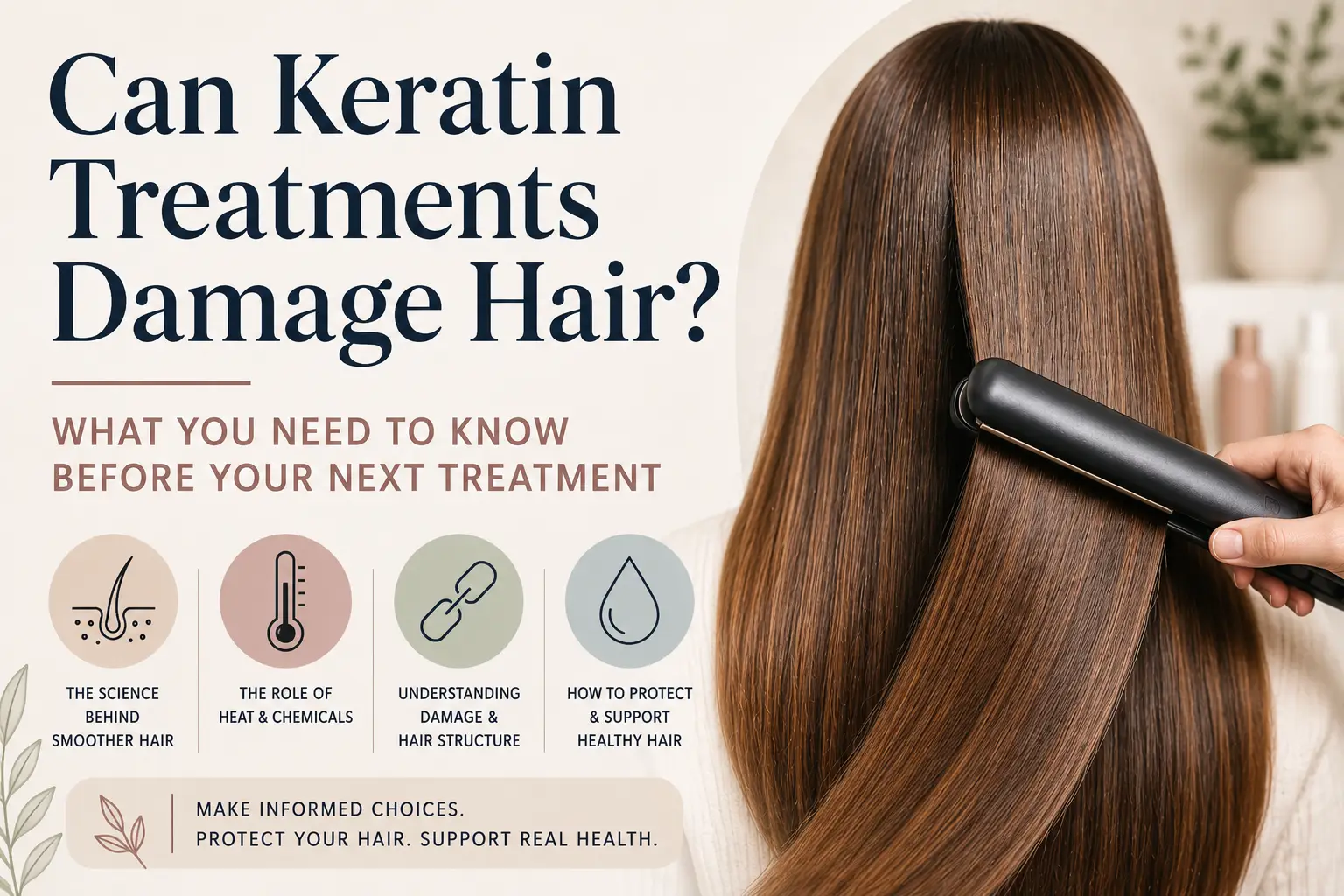
Can Keratin Treatments Damage Hair? What You Need to Know Before Your Next Treatment
Keratin treatments are often marketed as a way to “put keratin back into the hair” and restore smooth, shiny, frizz-free strands. But many people ask: “Can keratin treatments damage hair, especially when they are repeated over time?”
But scientifically, most smoothing or keratin treatments are not simply nourishing the hair with keratin. They usually work by chemically altering, coating, sealing, and heat-setting the hair fibre to force it into a smoother shape.
This can make the hair look healthier immediately, but that does not always mean the hair is stronger or truly repaired underneath.
At True to Life, we believe customers deserve to understand the difference between temporary cosmetic smoothness and long-term hair health.
Hair Is Held Together by Bonds
Hair is made mostly of keratin protein. Its shape, strength, curl pattern, and elasticity are influenced by different bonds and structures inside the hair fibre.
These include:
Disulfide bonds
which are strong structural bonds that help determine the hair’s natural curl or wave pattern.
Hydrogen bonds
which are weaker bonds affected by water, humidity, and heat.
Salt bonds
which are influenced by pH.
The internal protein structure
which gives the hair strength, flexibility, and resilience.
When hair has already been coloured, bleached, heat-styled, chemically treated, or repeatedly straightened, these bonds and the outer cuticle can become weakened. This makes the hair more vulnerable to further damage.
Can Keratin Treatments Damage Hair Instead of Repairing It?
The name “keratin treatment” can be misleading because many people assume it only restores keratin. This often leads to the question; “Can keratin treatments damage hair instead of repairing it?”
It sounds as if the treatment is simply replacing lost keratin and restoring the hair back to health.
But in practice, many smoothing treatments contain a combination of:
- film-forming agents
- smoothing polymers
- conditioning ingredients
- acids or aldehyde-type chemistry
- protein fragments
- silicones or silicone-like coating ingredients
- preservatives
- crosslinking ingredients,
- heat-activated smoothing compounds.
The treatment is then sealed into the outer layer of the hair using very high heat, usually with a flat iron.
So the result is not just repair. It is more like creating a temporary, smooth artificial layer around the hair fibre while forcing the hair into a sleeker shape.
This is why the hair can feel incredibly smooth, shiny, and easy to manage immediately after the treatment.
But that smoothness is not always the same as true hair health.
Can Keratin Treatments Damage Hair Because of High Heat?
This is one of the main reasons people wonder “Can keratin treatments damage hair even if the results look healthy at first?”
Most keratin treatments require the hair to be flat-ironed at very high temperatures.
This can be especially damaging for hair that is:
fine, coloured, grey, highlighted, bleached, fragile, dry, high porosity, thinning-looking, or already prone to breakage.
High heat can weaken the cuticle, reduce elasticity, increase brittleness, dry out already porous ends, and make fragile hair more prone to snapping.
The hair may look smoother because the cuticle has been flattened and sealed, but the heat process can still place stress on the underlying fibre.
This is one reason someone may love the immediate results of a keratin treatment but later notice their hair feels weaker, drier, flatter, or more fragile as the treatment starts to wear off.
The Cuticle Gets Sealed Down Artificially
The cuticle is the outer protective layer of the hair.
Healthy cuticles lie fairly flat, helping the hair reflect light and retain moisture. Damaged or porous hair often has raised, chipped, or uneven cuticles, which can make the hair feel rough, dry, frizzy, or difficult to manage.
Keratin treatments force the cuticle to lie flatter.
This creates:
more shine, less frizz, easier brushing, faster styling, and a silky feeling.
But this does not always mean the hair has become healthier.
It may simply mean the damage has been cosmetically masked.
That is why the hair can feel amazing immediately after a treatment, then gradually feel rougher, drier, or more fragile as the coating starts to wash out.
The Keratin Treatment Cycle
This is one of the biggest concerns with repeated hair smoothing treatments and one of the reasons keratin treatments can damage hair over time for some people.
When hair becomes used to being coated, sealed, and artificially smoothed, the customer may start to feel that their natural hair is “unmanageable” without another treatment.
The cycle can look like this:
- Hair feels frizzy, dry, or rough.
- A keratin treatment smooths and seals the hair.
- The hair feels shiny, sleek, and easier to style.
- The treatment gradually washes out.
- The underlying dryness, porosity, or damage becomes visible again.
- The customer books another keratin treatment.
- More heat and chemical processing are added.
- Over time, the hair can become weaker.
The customer experiences the smooth phase as “healthy hair,” but the rough phase may actually be the true condition of the hair underneath.
This creates dependency on smoothing treatments rather than supporting the hair’s natural recovery.
Keratin Treatments Can Interfere With Moisture and Conditioning Response
Hair needs a healthy balance of moisture, emollients, lipids, gentle cleansing, conditioning support, and protein when appropriate.
If the hair is repeatedly coated and sealed, nourishing ingredients may not interact with the hair fibre in the same way.
The hair may feel smooth on the outside but still be dry, brittle, or weak underneath.
This is why some people feel they are using many “repair” products, but their hair only behaves properly after a salon smoothing treatment.
The issue is not always that the hair needs more keratin.
Sometimes the hair needs less coating, less heat stress, better moisture balance, more suitable emollients, and a gentler long-term routine.
Can Keratin Treatments Damage Fine or Fragile Hair More Easily?
Keratin treatments can be much more problematic on fine or fragile hair because the strand has less structural mass to tolerate repeated stress.
Fine hair can be more vulnerable to:
high heat, tension from blow-drying and ironing, chemical processing, repeated colouring, brushing through tangles, and product build-up.
The result may look sleek for a while, but over time the hair can become flatter, weaker, more breakage-prone, and less full-looking.
While a keratin treatment may temporarily make hair look smoother, some people ask “Can keratin treatments damage hair that is already fragile?” This is especially important for customers who already feel their hair is thinning, shedding, ageing, or losing density
A keratin treatment may temporarily make hair look smoother, but it may not be the best long-term choice if the main concerns are strength, fullness, scalp health, and reducing breakage.
Can Keratin Treatments Damage Hair Over Time? Understanding Cumulative Damage
A keratin treatment does not always destroy the hair immediately.
Some people enjoy the results, especially if their hair is naturally coarse, strong, dense, and healthy enough to tolerate the process.
The concern is usually cumulative damage.
Risk increases when keratin treatments are layered on top of:
- colour
- bleach
- frequent heat styling
- ageing hair
- hormonal shedding
- low iron
- low protein levels
- fine texture
- already porous ends
- frequent washing
- repeated salon chemical services.
This is where many customers get stuck.
They are not seeing damage from one single event. They are seeing the result of many small stressors that have been repeated over time.
Why True to Life Takes a Different Approach
At True to Life, our focus is not to force the hair into temporary smoothness.
Our focus is to support the hair and scalp with a personalised routine that helps improve hair condition over time.
Instead of relying on heavy coating, sealing, and high-heat smoothing treatments, we focus on:
- gentle cleansing
- scalp health
- moisture balance
- natural emollients
- plant-based conditioning support
- suitable protein use when needed
- formulas adjusted to your hair’s porosity, density, texture, and damage history.
This is especially important for hair that is dry, porous, heat-damaged, chemically treated, or fragile.
Our goal is not to make the hair dependent on a treatment.
Our goal is to help the hair become softer, more manageable, more balanced, and healthier-feeling with consistent care.
The Role of Emollients in Hair Recovery
One of the key differences in True to Life formulations is our focus on emollients.
Emollients help soften, smooth, protect, and improve the feel of the hair. But unlike heavy synthetic coating agents, the right natural emollients can support the hair’s moisture balance in a more flexible and breathable way.
For damaged or high porosity hair, emollients can help reduce roughness, improve slip, reduce friction between strands, enhance natural shine, and make hair feel more comfortable and flexible.
This is not the same as coating the hair to hide damage.
It is about feeding the hair with the right type of conditioning support so it can gradually feel better over time.
Because True to Life formulas are personalised, the emollient balance is adjusted according to the customer’s hair type. Fine or low porosity hair may need lighter conditioning, while dry, porous, or damaged hair may need richer emollient support.
This personalised approach helps avoid the common problem of using products that are either too heavy, too stripping, too protein-heavy, or not nourishing enough.
What to Expect When Moving Away From Keratin Treatments
When someone stops doing keratin treatments, their hair may initially feel different.
It may feel less silky, less slippery, more textured, or more frizz-prone.
This does not mean the natural routine is failing.
It often means the artificial coating is no longer masking the hair’s true condition.
During this transition, the focus should be on:
- gentle cleansing
- consistent conditioning
- regular moisture support
- reducing heat styling
- protecting the ends
- avoiding harsh chemical overlap
- giving the hair time to recover.
Hair recovery takes time because damaged lengths cannot be instantly restored. The goal is to improve manageability, reduce further damage, support healthier new growth, and gradually improve the feel of existing hair.
How Long Does Hair Take to Recover After Keratin Treatments?
Every head of hair is different, but a realistic timeline may look like this:
In the first 2 to 4 weeks, the hair and scalp may start adjusting to a gentler routine.
Within 4 to 8 weeks, the hair may begin to feel softer, lighter, and more balanced.
After 2 to 4 months, customers may notice better manageability, improved moisture response, and less dependence on heavy smoothing products.
After 6 months or more, the biggest improvement often comes from healthier new growth and reduced repeated damage.
The more damaged the hair is, the longer the recovery process may take.
This is why consistency matters.
R369.00
Estimated delivery dates: Sep 24, 2026 - Sep 29, 2026
R339.00
Estimated delivery dates: Sep 24, 2026 - Sep 29, 2026
R515.00
Estimated delivery dates: Sep 24, 2026 - Sep 29, 2026
R309.00
Estimated delivery dates: Sep 24, 2026 - Sep 29, 2026
R918.00 – R1,402.00Price range: R918.00 through R1,402.00
Estimated delivery dates: Sep 25, 2026 - Sep 30, 2026
R279.00
Estimated delivery dates: Sep 24, 2026 - Sep 29, 2026
R499.00
Estimated delivery dates: Sep 25, 2026 - Sep 30, 2026
R269.00
Estimated delivery dates: Sep 25, 2026 - Sep 30, 2026
R499.99
Estimated delivery dates: Sep 25, 2026 - Sep 30, 2026
R269.00
Estimated delivery dates: Sep 25, 2026 - Sep 30, 2026
R969.00
Estimated delivery dates: Sep 25, 2026 - Sep 30, 2026
R499.00
Estimated delivery dates: Sep 25, 2026 - Sep 30, 2026
R269.00
Estimated delivery dates: Sep 24, 2026 - Sep 29, 2026
R249.00
Estimated delivery dates: Sep 24, 2026 - Sep 29, 2026
Start your hair growth journey with us.
Take the Hair Assessment to get a your recommended products to support your hair growth journey
Can Keratin Treatments Damage Hair Final Thoughts
Keratin treatments can make hair look smoother, shinier, and easier to manage in the short term.
But they are not simply “adding keratin back into the hair.” Many people wonder: “Can keratin treatments damage hair”, because the long-term effects are not always obvious immediately.
Most smoothing treatments work by chemically altering, coating, sealing, and heat-setting the hair fibre. For some hair types, especially fine, fragile, coloured, bleached, or thinning-looking hair, this can contribute to long-term dryness, brittleness, and breakage.
At True to Life, we believe healthy hair should not depend on repeated coating and high-heat smoothing treatments.
Our approach is different.
We focus on personalised natural hair care that supports the scalp, nourishes hair with the right emollients, improves moisture balance, and helps hair feel healthier over time.
The goal is not temporary smoothness.
The goal is hair that feels stronger, softer, more balanced, and more like itself again.
Related Articles
How to Tell If Your Hair Is Damaged: Signs & Solutions

Hair Feels Like Straw? How to Restore Softness
How to Grow Longer Hair Without Constant Breakage
Hair Routine Isn’t Working? What You Need to Know
Recovery for Heat-Damaged Hair: How to Restore Dry, Frizzy Ends
Why Does My Hair Look Stringy and Dry? Causes, Fixes & How to Bring Curls Back to Life
Post Views: 237