Skip to content
Free shipping on orders over R980 | First order? Get 10% off orders of R499 and above instead

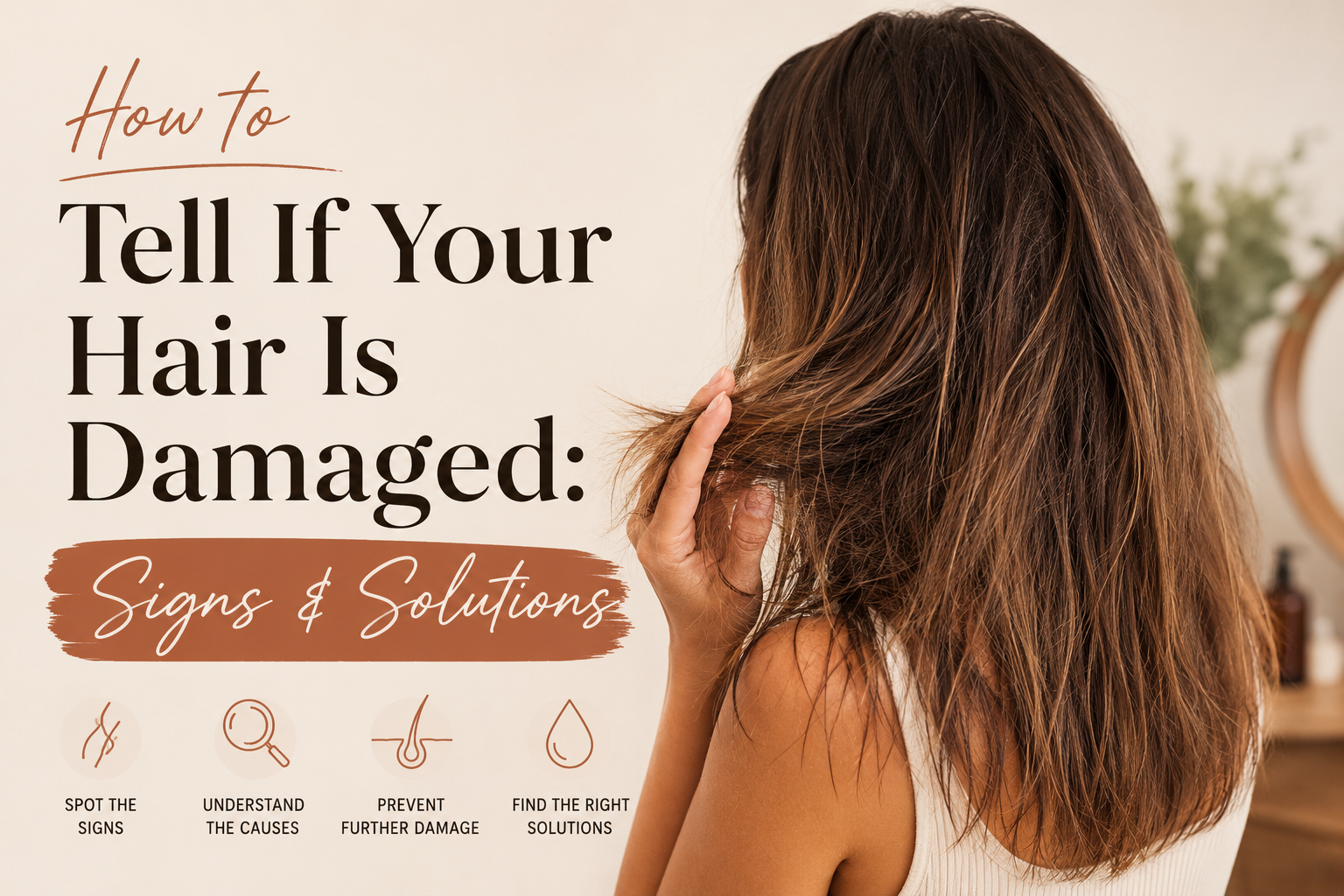
How to Tell If Your Hair Is Damaged: Signs & Solutions
Knowing how to tell if your hair is damaged can help you understand what your hair actually needs, rather than constantly changing products and hoping something works. Hair damage can happen gradually, so you may not notice it until your hair starts behaving differently.
Your hair may feel rougher, tangle more easily, look dull, or break more often. These changes can be signs that your hair needs more protection and care.
The good news is that once you know how to tell if your hair is damaged, you can take steps to prevent further damage and improve the way your hair looks and feels.
How to Tell If Your Hair Is Damaged: The Most Common Signs
Hair damage doesn’t always look the same for everyone. Some people notice obvious breakage, while others first notice changes in texture, shine, or how their hair responds to their usual routine.
Here are some of the most common signs to look out for.
Your Hair Feels Rough or Straw-Like
Healthy hair should generally feel relatively smooth to the touch. If your hair suddenly feels rough, coarse, or straw-like, especially through the lengths and ends, it may be a sign of damage.
However, rough-feeling hair can also be caused by dryness or product build-up. This is why one symptom alone doesn’t necessarily tell you whether your hair is damaged.
Your Hair Tangles More Easily
If your hair has suddenly become difficult to detangle, pay attention.
Damage to the outer cuticle can make the hair surface less smooth, allowing individual strands to catch onto each other more easily. This can lead to more knots and increased tension during brushing or detangling.
And the more aggressively you have to detangle your hair, the greater the risk of breakage.
You Are Seeing More Breakage
One of the clearest ways to tell if your hair is damaged is to look at how much hair is actually breaking.
Breakage is different from normal shedding. Shed hairs usually come from the scalp naturally, while broken hairs are pieces of the hair shaft.
If you’re regularly finding short pieces of hair around your clothes, pillow, shower, or brush, your strands may be experiencing too much mechanical or chemical stress.
Your Ends Look Thin or Uneven
Look closely at your ends.
If they appear noticeably thinner than the rest of your hair, look frayed, or seem to disappear into wispy little pieces, this can be a sign of accumulated damage and breakage.
The ends are also the oldest part of your hair, so they have experienced the most brushing, washing, heat, friction, and environmental exposure over time.
You Have More Split Ends
Split ends are another common sign of hair damage.
Once a strand splits, the damaged section cannot permanently fuse itself back together. Products can temporarily make the ends look smoother, but the split itself remains.
Regular trims can remove existing split ends, while reducing heat, friction, and rough handling can help prevent new ones from developing.
Your Hair Has Lost Its Shine
Hair that suddenly looks duller than usual may be showing signs of damage.
When the cuticle is relatively smooth, light can reflect more evenly from the surface of the hair. Damage and roughness can disrupt that smooth surface, making hair appear less shiny.
That said, dullness can also come from product build-up, mineral deposits, dryness, or simply your natural hair texture, so shine alone isn’t enough to diagnose damage.
Your Hair Feels Very Dry
Dryness and damage are closely related, but they aren’t the same thing.
Hair that feels dry may lack the moisture and lubrication needed to feel soft and manageable. Damaged hair can also become more difficult to keep moisturised because changes to the cuticle can affect how the strand interacts with water and conditioning ingredients.
If persistent dryness appears alongside roughness, tangling, split ends, and breakage, there may be more going on than simple dryness.
Your Hair Feels Different When Wet
Pay attention to how your hair behaves when you wash it.
Hair that suddenly feels unusually rough, tangled, overly stretchy, or weak when wet may have experienced significant stress.
Very damaged hair can also become more fragile when wet, making gentle handling particularly important during washing and detangling.
Your Hair Doesn’t Behave Like It Used To
Sometimes the easiest way to tell if your hair is damaged is simply to notice a change.
Perhaps your hair used to feel soft after conditioning but now feels rough. Maybe your ends used to look full but have gradually become thin. Or perhaps your usual styling routine suddenly isn’t giving you the same results.
Changes in your hair’s behaviour can be useful clues, especially when several signs appear at the same time.
How to Tell If Your Hair Is Damaged or Just Dry
This is where things can get confusing.
Dry hair isn’t automatically damaged hair.
Your hair can feel dry because of weather, overwashing, cleansing products, insufficient conditioning, or your natural hair characteristics. Damage, on the other hand, involves changes to the physical structure of the hair strand.
The two can also happen together.
A useful way to think about it is:
- Dryness affects how your hair feels and behaves.
- Damage affects the physical structure of the hair.
- Breakage occurs when weakened hair physically snaps.
- Split ends are a visible form of structural damage at the ends of the strand.
If you’re trying to figure out how to tell if your hair is damaged, don’t focus on one symptom. Look for a pattern of changes.
What Causes Hair Damage?
Understanding what caused the damage can be just as important as recognising it.
Heat Styling
Frequent use of straighteners, curling irons, and high-heat blow-drying can put stress on the hair shaft.
The higher the temperature and the more frequently heat is used, the greater the potential for damage.
Bleaching and Chemical Processing
Bleaching and other chemical treatments can significantly alter the structure of the hair.
Repeated processing, especially when the hair is already compromised, can increase dryness, porosity, breakage, and split ends.
Excessive Brushing and Detangling
Your hair can be damaged by mechanical stress too.
Rough brushing, pulling through stubborn knots, brushing aggressively from root to tip, or repeatedly manipulating the same areas can contribute to breakage.
Tight Hairstyles
Constant tension from tight ponytails, buns, braids, extensions, or other hairstyles can put stress on the hair.
Changing hairstyles, avoiding excessive tension, and giving your hair regular breaks can help reduce unnecessary stress.
Friction
Your hair experiences friction every day.
Pillows, towels, clothing, scarves, and even repeated rubbing between strands can contribute to wear over time.
Being gentler with your hair when it is wet and minimising unnecessary friction can help protect the lengths and ends.
Can Damaged Hair Repair Itself?
This is one of the most important things to understand about hair damage.
The hair shaft is made from keratin and is not living tissue, so severely damaged areas cannot literally heal themselves back to their original condition.
However, that doesn’t mean you’re stuck with unhealthy-looking hair.
Conditioning treatments and protective hair care can improve the feel, appearance, manageability, and resilience of damaged hair. More importantly, you can reduce the amount of new damage your hair experiences while allowing healthier new growth to come through.
The goal isn’t to magically reverse every damaged strand. It’s to protect the hair you have, prevent further damage, and retain as much healthy length as possible.
How to Care for Damaged Hair
Once you understand how to tell if your hair is damaged, the next step is changing the habits that may be contributing to the problem.
Try to:
- Handle your hair gently, especially when it is wet.
- Reduce unnecessary heat styling.
- Avoid repeatedly processing already fragile hair.
- Detangle slowly, starting at the ends and working upwards.
- Avoid hairstyles that place constant tension on your strands.
- Keep your lengths and ends conditioned.
- Pay attention to how your hair responds to your routine.
- Trim severely split or damaged ends when necessary.
- Protect your hair from unnecessary friction.
Most importantly, don’t assume that adding more products will automatically solve the problem.
Sometimes your hair needs less manipulation, not another product layered onto it.
Your Hair Is Giving You Clues
Learning how to tell if your hair is damaged isn’t about finding one perfect test. It’s about noticing changes.
Is your hair breaking more? Are your ends becoming thinner? Is detangling suddenly much harder? Does your hair feel rough even after conditioning? Has your texture or overall behaviour changed?
These clues can help you understand what your hair may need.
At True to Life™, we believe hair care should be personalised because your hair isn’t identical to anyone else’s. Your routine should take into account your hair’s condition, your scalp, your lifestyle, and what your hair has been exposed to over time.
Instead of constantly chasing the latest solution, start by understanding what your hair is actually telling you.
How to Prevent Hair Damage in the Future
You don’t need completely perfect hair habits to protect your hair.
Small changes can make a meaningful difference over time. Reducing excessive heat, being gentler when detangling, protecting your ends, and paying attention to changes in your hair can all help minimise unnecessary wear.
The goal is not to avoid every source of damage forever. It’s to create a routine that gives your hair the best chance to stay strong and retain the length you grow.

R369.00
Estimated delivery dates: Sep 21, 2026 - Sep 24, 2026

R339.00
Estimated delivery dates: Sep 21, 2026 - Sep 24, 2026

R515.00
Estimated delivery dates: Sep 21, 2026 - Sep 24, 2026

R309.00
Estimated delivery dates: Sep 21, 2026 - Sep 24, 2026

R1,897.00 – R2,480.00Price range: R1,897.00 through R2,480.00
Estimated delivery dates: Sep 21, 2026 - Sep 24, 2026

R944.00 – R1,396.00Price range: R944.00 through R1,396.00
Estimated delivery dates: Sep 21, 2026 - Sep 24, 2026

R918.00 – R1,402.00Price range: R918.00 through R1,402.00
Estimated delivery dates: Sep 22, 2026 - Sep 25, 2026
R911.00 – R958.00Price range: R911.00 through R958.00
Estimated delivery dates: Sep 21, 2026 - Sep 24, 2026
R745.00 – R1,213.00Price range: R745.00 through R1,213.00
Estimated delivery dates: Sep 21, 2026 - Sep 24, 2026
R189.99
Estimated delivery dates: Sep 21, 2026 - Sep 24, 2026
R279.00
Estimated delivery dates: Sep 21, 2026 - Sep 24, 2026
R279.00
Estimated delivery dates: Sep 21, 2026 - Sep 24, 2026
R379.00
Estimated delivery dates: Sep 21, 2026 - Sep 24, 2026
R439.99
Estimated delivery dates: Sep 21, 2026 - Sep 24, 2026
R369.00
Estimated delivery dates: Sep 21, 2026 - Sep 24, 2026
R349.00
Estimated delivery dates: Sep 21, 2026 - Sep 24, 2026
R349.00
Estimated delivery dates: Sep 21, 2026 - Sep 24, 2026
R349.00
Estimated delivery dates: Sep 21, 2026 - Sep 24, 2026
R499.00
Estimated delivery dates: Sep 22, 2026 - Sep 25, 2026
R269.00
Estimated delivery dates: Sep 22, 2026 - Sep 25, 2026
Start your hair growth journey with us.
Take the Hair Assessment to get a your recommended products to support your hair growth journey
Final Thoughts
If you’ve been wondering how to tell if your hair is damaged, start by looking at the bigger picture.
Roughness, dryness, tangling, split ends, thinning ends, dullness, and breakage can all be clues. But one symptom doesn’t necessarily mean your hair is damaged. Look for several changes happening together and consider what your hair has been exposed to.
Most importantly, damaged hair doesn’t mean your hair is beyond help. With gentler handling, consistent care, and fewer sources of unnecessary stress, you can protect your existing length and give healthier new growth the chance to thrive.
Your hair doesn’t need to be perfect. It just needs to be understood.
Post Views: 91