Skip to content
Free shipping on orders over R980 | First order? Get 10% off orders of R499 and above instead

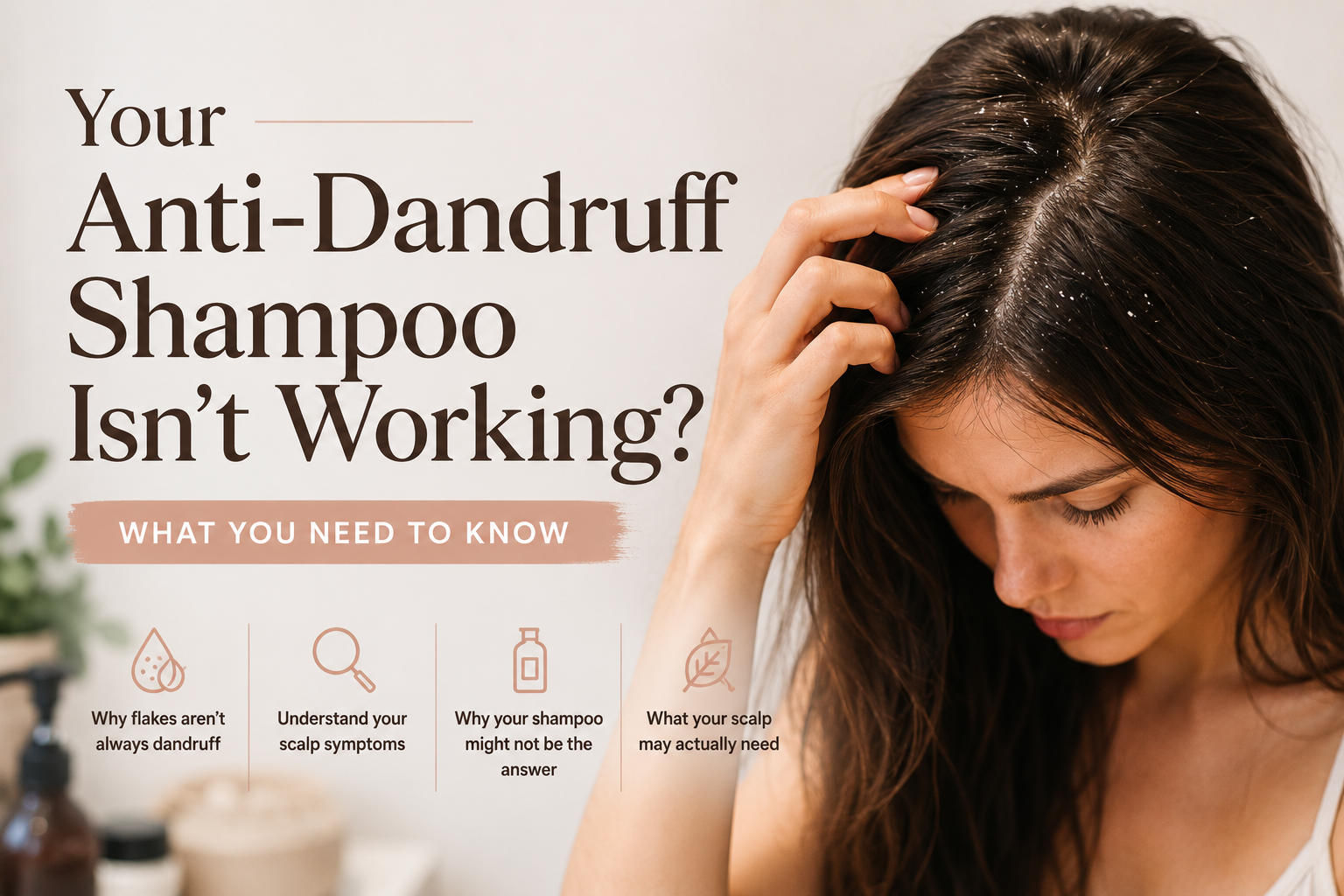
Your Anti-Dandruff Shampoo Isn’t Working? What You Need to Know
You notice flakes on your shoulders, your scalp feels itchy, and your first thought is probably: I need an anti-dandruff shampoo.
It seems straightforward. Dandruff causes flakes, so an anti-dandruff shampoo should fix them. But what happens when you keep using one, and your scalp still feels itchy, flaky or irritated?
Before reaching for an even stronger formula, it may be worth asking a different question: is dandruff actually the problem?
Flaking can have several different causes, and they do not all respond to the same type of care. From a dry scalp and product build-up to eczema, psoriasis and seborrhoeic dermatitis, what looks like dandruff at first glance may be something else entirely.
Here are some of the reasons your anti-dandruff shampoo may not be working, and what your scalp could actually be trying to tell you.
You Might Not Actually Have Dandruff
One of the most common mistakes is assuming that every flaky scalp has dandruff.
While dandruff can cause visible flakes and itching, similar symptoms can occur with several other scalp concerns.
Dry, flaky scalp
A dry scalp can produce small, loose flakes and may feel tight, uncomfortable or irritated. If dryness is the underlying issue, repeatedly using a strong anti-dandruff shampoo may not address what your scalp actually needs.
Eczema
Scalp eczema can cause dryness, itching, redness and flaking. It can sometimes look similar to dandruff, but the underlying cause and appropriate treatment can be different.
Psoriasis
Scalp psoriasis can cause more defined, thicker patches of scaling and inflammation. It is not simply a more severe form of dandruff, and using an anti-dandruff shampoo alone may not be enough to manage it.
Seborrhoeic dermatitis
Seborrhoeic dermatitis can cause persistent flaking, itching, redness and sometimes greasy or yellowish scales. It can look similar to dandruff, but tends to be more persistent and inflammatory.
Product irritation or build-up
Sometimes the issue is not dandruff at all. A reaction to a haircare or styling product, excessive product build-up or frequent use of dry shampoo can leave the scalp feeling uncomfortable and flaky.
The important takeaway? Flakes are a symptom, not necessarily a diagnosis.
If your dandruff shampoo isn’t working, identifying the actual cause of flaking is an important first step.
You May Be Using Anti-Dandruff Shampoo Too Often
More shampoo does not necessarily mean better results.
Depending on the formula and your scalp, using an anti-dandruff shampoo more frequently than recommended can cause dryness or irritation.
This can become a frustrating cycle. You notice more flakes, so you use the shampoo more often. Your scalp becomes irritated or dry, you notice more flaking, and you assume you need to use even more of the shampoo.
Always follow the directions provided with your specific product rather than assuming that daily use will produce faster results.
You May Not Be Using Anti-Dandruff Shampoo Correctly
Even an appropriate anti-dandruff shampoo may not work as expected if it is not being used according to its instructions.
Some formulations are designed to sit on the scalp for a certain amount of time before being rinsed, allowing their active ingredients to work. Others may have different recommended frequencies of use.
Pay attention to the instructions on the bottle, and make sure you are actually applying the shampoo to your scalp, rather than focusing mainly on the lengths of your hair.
Your scalp is where the concern is occurring, so that is where your cleansing routine should be focused.
The Active Ingredient in Your Anti-Dandruff Shampoo May Not Be Right for Your Scalp
Not every anti-dandruff shampoo works in the same way.
Different products can contain different active ingredients, and what works well for one person’s scalp may not produce the same results for someone else.
If you have been using an anti-dandruff shampoo consistently and according to its directions without seeing improvement, constantly switching between random products may not be the best approach.
Instead, consider what your scalp is actually experiencing and whether the product you are using is appropriate for that concern.
Your Scalp May Be Irritated
If your scalp is already irritated, adding more and more treatments can sometimes make things worse.
A scalp that feels sore, tight, excessively dry, itchy or uncomfortable may need a gentler approach rather than increasingly aggressive cleansing.
This is especially important if you have recently introduced a new shampoo, styling product, treatment or scalp product.
Think about what changed around the time your symptoms started or became worse. Sometimes the most useful clue is not what you are missing from your routine, but what you recently added.
Product Build-Up Could Be Making Things Worse
Your scalp comes into contact with more than just shampoo.
Styling creams, gels, oils, dry shampoo, hairspray and other products can accumulate on the scalp, particularly when they are used frequently or applied directly to the roots.
Build-up does not automatically mean you have dandruff, but it can contribute to an uncomfortable or congested-feeling scalp and may make existing flaking more noticeable.
This is why a good scalp care routine should consider everything that comes into contact with your scalp, not just your shampoo.
Your Scalp and Hair May Need Different Things
This is one of the easiest things to overlook.
Your scalp and your lengths are technically part of the same head of hair, but they can have completely different needs.
You might have an oily or flaky scalp while your ends are dry and prone to breakage. Or your scalp may become irritated easily while your lengths need additional moisture.
That means your entire routine does not necessarily need to be based around one product or one concern.
Focus your cleansing and scalp care where it is needed, while giving the lengths of your hair the conditioning and protection they require.
Healthy hair care starts with understanding both the scalp and the hair, rather than treating them as the same thing.
You May Be Treating the Flakes Instead of the Cause
It can be tempting to focus entirely on what you can see.
If there are flakes, you want to get rid of the flakes. If there is itching, you want something that makes the itching stop.
But visible symptoms do not always tell you what is happening underneath.
If your scalp continues to flake despite using anti-dandruff shampoo correctly, repeatedly trying different products may only mask the bigger issue.
Instead, take a step back and look at the overall picture:
- Is your scalp oily or dry?
- Is there redness or inflammation?
- Are the flakes small and loose, or thicker and more defined?
- Does your scalp feel tight, sore or itchy?
- Have you recently changed your haircare routine?
- Are you using a lot of styling products or dry shampoo?
- Does the problem keep returning despite treatment?
These details can help you understand whether you are actually dealing with dandruff or something that requires a different approach.
When Should You See a Professional?
Not every flaky scalp needs a trip to the dermatologist. However, persistent or severe symptoms should not simply be ignored or treated indefinitely with different shampoos.
Consider speaking to a dermatologist or other qualified healthcare professional if you experience significant redness, inflammation, soreness, thick or persistent patches, bleeding, substantial itching, hair loss, or symptoms that do not improve with appropriate care.
Conditions such as eczema, psoriasis and seborrhoeic dermatitis may require a more specific treatment plan than an anti-dandruff shampoo can provide.
And importantly, you do not need to diagnose yourself. If you are unsure what is causing your symptoms, getting professional advice can save you from spending months trying products that are not suited to your scalp.
The True to Life™ Approach to Scalp Care
At True to Life™, we believe understanding your scalp comes before choosing your products. If you’re dealing with flakes, itching, dryness or irritation, the first step is figuring out what your scalp may actually need rather than automatically reaching for another generic off-the-shelf product.
That is why our approach to haircare starts with personalisation. Your scalp and hair have their own needs, and your routine should reflect them.
Not sure where to start? Our hair assessment can help you identify your scalp and hair type and point you towards a routine suited to your individual needs. If you need a little more guidance, True to Life™ also offers free 15-minute consultations, where you can discuss your specific scalp and hair concerns with us.

R918.00 – R1,402.00Price range: R918.00 through R1,402.00
Estimated delivery dates: Sep 28, 2026 - Oct 1, 2026
R379.00
Estimated delivery dates: Sep 25, 2026 - Sep 30, 2026
R369.00
Estimated delivery dates: Sep 25, 2026 - Sep 30, 2026
R349.00
Estimated delivery dates: Sep 25, 2026 - Sep 30, 2026
R349.00
Estimated delivery dates: Sep 25, 2026 - Sep 30, 2026
R349.00
Estimated delivery dates: Sep 25, 2026 - Sep 30, 2026

R499.00
Estimated delivery dates: Sep 28, 2026 - Oct 1, 2026
R269.00
Estimated delivery dates: Sep 28, 2026 - Oct 1, 2026
R499.99
Estimated delivery dates: Sep 28, 2026 - Oct 1, 2026
R269.00
Estimated delivery dates: Sep 28, 2026 - Oct 1, 2026
R969.00
Estimated delivery dates: Sep 28, 2026 - Oct 1, 2026
R499.00
Estimated delivery dates: Sep 28, 2026 - Oct 1, 2026

R329.00
Estimated delivery dates: Sep 25, 2026 - Sep 30, 2026
Start your hair growth journey with us.
Take the Hair Assessment to get a your recommended products to support your hair growth journey
Final Thoughts
If your anti-dandruff shampoo isn’t working, don’t assume that you simply need a stronger product. Persistent flakes can have several different causes, and the right approach depends on what is actually happening on your scalp.
Pay attention to the signs your scalp is giving you, consider your entire haircare routine, and don’t be afraid to seek professional advice when something doesn’t seem right.
Healthy hair starts with a healthy, understood scalp. At True to Life™, we believe your haircare routine should be guided by what your scalp and hair actually need, not simply by the symptoms you can see.
Post Views: 99