Free shipping on orders over R980 | First order? Get 10% off orders of R499 and above instead

“#2 Strengthen & Restore Scalp Oil” has been added to your basket. View basket
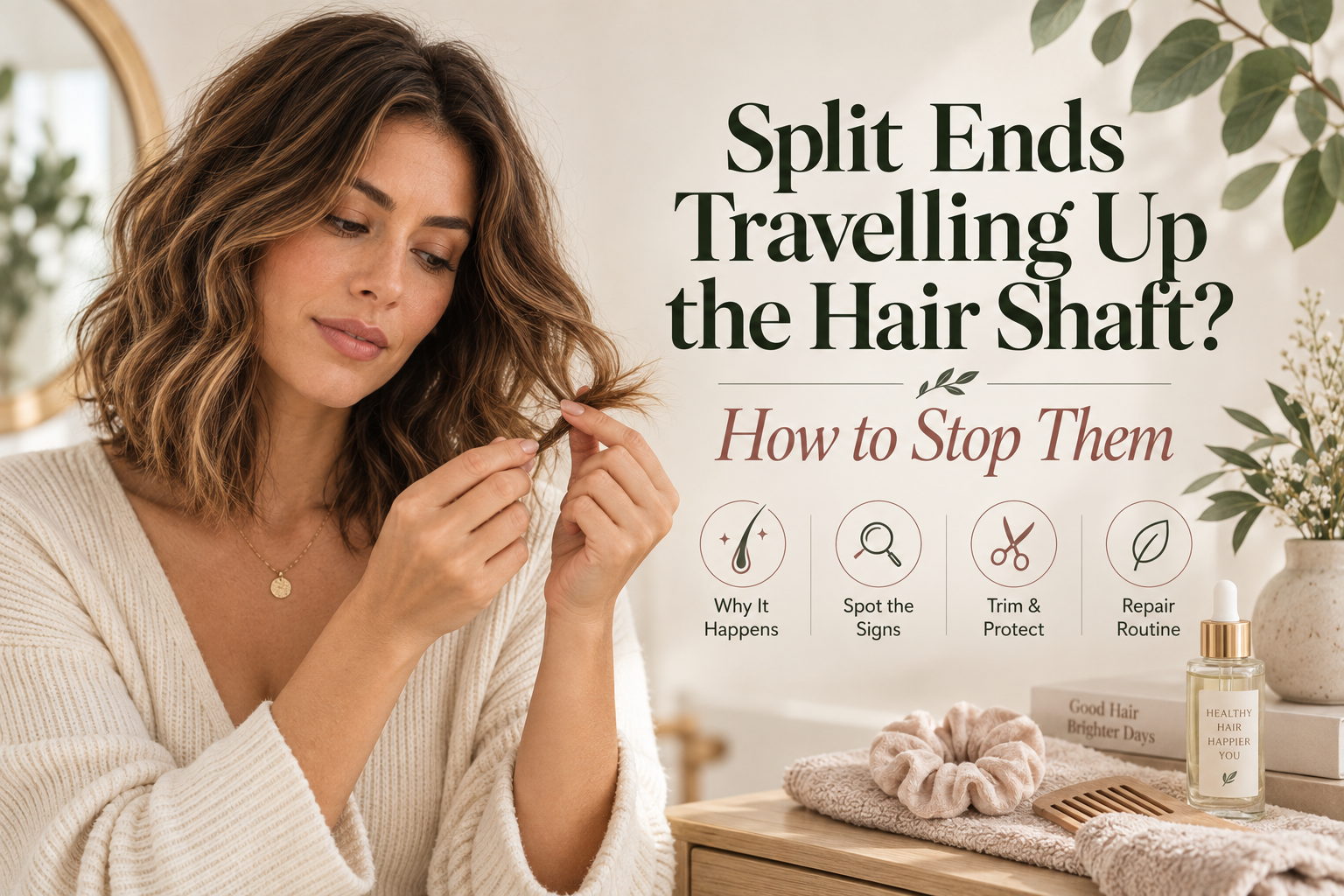
Split Ends Travelling Up the Hair Shaft? How to Stop Them
You notice a split at the very end of your hair, so you trim it. A few weeks later, you spot another split, except this time it seems to be sitting further up the strand. Then another appears. Before long, your hair feels rough, tangles more easily, and seems to be breaking faster than it can grow.
So, can split ends really travel up the hair shaft?
Yes, a damaged hair fibre can keep splitting and fraying beyond the original point of damage. While the split itself doesn’t literally crawl up your hair, damage can progress along the shaft when you don’t address the underlying causes.
Understanding why this happens is an important part of learning how to prevent split ends. Rather than simply treating the ends once they become visibly damaged, it helps to look at what your hair has been exposed to over time and what may be causing the damage in the first place.
What Causes Split Ends to Travel Up the Hair Shaft?
A split end starts when the protective outer layer of the hair fibre becomes damaged. Once the strand’s structure is compromised, the fibre can begin to fray or separate.
This damage can progress further up the strand, particularly when the hair continues to experience the same stress that caused the original split.
Some of the most common causes include:
- Repeated heat styling
- Bleaching, colouring and other chemical processes
- Rough brushing or detangling
- Excessive manipulation
- Friction from clothing, towels or bedding
- Lack of conditioning and lubrication
- Repeated mechanical stress on already fragile hair
- Environmental exposure
This is why split ends and hair breakage often go hand in hand. Once the hair fibre weakens, it becomes more susceptible to further damage.
Your Split Ends Didn’t Happen Overnight
One of the easiest things to forget about your hair is that the ends are the oldest part of the strand.
While your roots are constantly producing new hair, the ends have been with you for months or even years. During that time, they have experienced washing, brushing, styling, sleeping, tying up, friction, environmental exposure and everything else that happens to your hair day after day.
Think about how much your hair has been through.
You may have straightened it hundreds of times. You may have brushed through thousands of tangles. You may have coloured or lightened it. You may wear it in the same hairstyle regularly. You may sleep with it loose against your pillow every night.
Your ends carry the history of all of that.
That is why split ends are rarely caused by a single event. In many cases, visible splitting results from cumulative damage that has been building for a long time.
What Causes Split Ends in the First Place?
Before you can prevent split ends, you need to understand what stresses your hair.
Repeated Heat Styling
Straighteners, curling irons, and other hot tools can place significant stress on hair, especially when used frequently or at high temperatures.
Repeated exposure can contribute to dryness and weakening of the hair fibre. If heat styling is part of your regular routine, reducing unnecessary heat and using appropriate heat protection can help limit ongoing damage.
Chemical Processing
Bleaching, colouring, relaxing and other chemical treatments can alter the structure of the hair.
This does not mean that chemically treated hair is automatically unhealthy. However, repeatedly processing the same sections of hair, particularly the lengths and ends, can leave them more vulnerable to damage.
Rough Brushing and Detangling
Tangles create resistance. Pulling aggressively through them can place mechanical stress on individual strands and contribute to breakage and splitting.
The goal isn’t to avoid brushing altogether. It’s to consider how you’re brushing, how tangled your hair is, what tool you’re using and whether you’re putting unnecessary force through the ends.
Friction
Your hair is constantly exposed to friction.
It can rub against clothing, towels, scarves, pillowcases, car headrests and even your own shoulders throughout the day.
Repeated friction may not cause a dramatic problem after one occurrence, but hair damage is often cumulative. The same small source of friction repeated day after day can matter over time.
Excessive Manipulation
Constantly touching, rearranging, brushing, twisting and restyling your hair can create more mechanical stress than you realise.
If your hair is already fragile or damaged, repeated manipulation can make the problem worse.
Dryness and Lack of Lubrication
Dry-feeling hair can be harder to manage because individual strands may rub against each other more.
Conditioning and appropriate haircare can help improve manageability and reduce friction during handling. However, remember that adding moisture or conditioning products does not undo an existing split.
Why Do Split Ends Keep Coming Back?
This is where things can become frustrating.
You trim your ends. You buy a new mask. You change your shampoo. You start being more careful with your hair.
And then the split ends come back.
That doesn’t necessarily mean your products aren’t working.
Your haircare products are only one part of the equation.
If the underlying source of damage remains, new splits can keep appearing.
For example, someone might use an excellent conditioning routine but still straighten their hair every day. Someone else might have healthy-looking hair but repeatedly pull through severe tangles. Another person may have very fragile ends that constantly rub against clothing or get pulled into tight hairstyles.
The question isn’t simply, “Am I using good products?”
It’s also:
“What is my hair experiencing every day?”
That distinction matters when you’re trying to understand how to stop split ends from coming back repeatedly.
Can Split Ends Actually Be Repaired?
This is one of the biggest misconceptions surrounding split ends.
Once a hair fibre has genuinely split, you cannot permanently fuse that damaged fibre back into its original intact state.
Some haircare products can temporarily smooth damaged areas, improve the feel of the hair and make split ends less noticeable. This can help manage the appearance and feel of damaged hair.
However, repairing the appearance of a split is not the same as restoring the strand to its original condition.
The most reliable way to remove an existing split is to cut above the damaged section.
That doesn’t mean you need to cut off all of your progress every time you notice a split.
The more useful approach is to identify why your hair is splitting in the first place and make changes that help prevent split ends from continuing to develop.
How to Prevent Split Ends From Travelling Further
If you’re trying to prevent split ends, the goal isn’t simply to find a product that makes your ends feel smoother. It’s to reduce the repeated stress your hair is experiencing.
Handle Your Hair Gently
Be particularly careful with your ends when brushing, detangling and styling.
Work through tangles patiently rather than repeatedly pulling through them. Avoid treating your hair as though every strand can withstand the same amount of force.
Reduce Unnecessary Heat
If you use hot tools regularly, consider whether every styling session is necessary.
Reducing how often you use heat, avoiding unnecessarily high temperatures and using heat protection can all help reduce cumulative stress on the hair.
Protect Your Ends From Friction
Pay attention to what your hair is rubbing against throughout the day and night.
When appropriate, keep your hair contained, choose gentler fabrics, and consider how you sleep with your hair to reduce repeated mechanical friction.
Be Mindful When Detangling
Detangling should be a process, not a battle.
Start where the hair needs the least force, then work through areas of resistance rather than dragging a brush or comb from the roots through a tangled length.
Consider Your Chemical History
If you regularly colour, bleach, or chemically process your hair, consider how often you treat the same lengths.
Your newest growth and your oldest ends don’t necessarily have the same needs. The ends may require considerably more care because they’ve already experienced months or years of processing and manipulation.
Keep Your Hair Conditioned and Manageable
Conditioning can help improve slip, softness and manageability, making the hair easier to handle.
The goal isn’t to make your hair feel artificially coated. It’s to support the condition and manageability of the hair so you’re not constantly fighting through tangles and friction.
Don’t Ignore Early Signs of Damage
Split ends aren’t the only sign your hair may be struggling.
Look out for:
- Increasing tangles
- Rough or uneven ends
- White dots along individual strands
- Tiny forks or splits
- Excessive breakage
- Ends that look increasingly thin
- Hair that feels significantly different from the rest of the length
Catching changes early gives you a chance to adjust your routine before the damage becomes more extensive.
Trim When Necessary
Trimming doesn’t make your hair grow faster, but it can remove damaged sections before they cause more problems.
If you’re trying to retain length, the goal isn’t necessarily to cut large amounts of hair frequently. It’s to manage damage strategically while addressing the habits that are contributing to it.
How to Prevent Split Ends in the Long Term
If you’re constantly asking how to get rid of split ends, it may be worth asking a different question.
Instead of only asking:
“How do I get rid of this split?”
Ask:
“Why did this split happen?”
That shift can make a significant difference.
If your ends are repeatedly splitting, look at your entire routine.
How often do you use heat?
How do you detangle?
How often do you colour or chemically process your hair?
How tightly do you wear your hair?
How much friction are your ends exposed to?
How frequently are you manipulating them?
Your hair may not need more products. It may need less stress.
Your Hair Has a History
Your hair doesn’t exist in a vacuum.
Two people can use the same shampoo, conditioner and hair mask and have completely different results because their hair has different histories.
One person’s hair may be virgin and rarely styled. Another person’s may have been bleached several times. One person may have fine, fragile strands that tangle easily, while another may have a different texture and density with completely different needs.
Even the same person’s hair can change over time.
That’s why understanding your hair means looking beyond labels such as “dry”, “frizzy”, or “damaged”. Your current hair condition is influenced by what your hair has experienced, how you handle it and what you expose it to now.
At True to Life™, we believe your haircare should reflect that.
Instead of relying solely on generic off-the-shelf products, consider the bigger picture: your hair’s current condition, texture, routine, styling habits, and the type of damage you’re actually experiencing.
If your hair has suddenly become more prone to splitting or breakage, that may be a sign that your routine needs to be reassessed.
Your hair changes.
Your haircare can change with it.

R369.00
Estimated delivery dates: Sep 25, 2026 - Sep 30, 2026
R339.00
Estimated delivery dates: Sep 25, 2026 - Sep 30, 2026

R515.00
Estimated delivery dates: Sep 25, 2026 - Sep 30, 2026

R309.00
Estimated delivery dates: Sep 25, 2026 - Sep 30, 2026

R1,897.00 – R2,480.00Price range: R1,897.00 through R2,480.00
Estimated delivery dates: Sep 25, 2026 - Sep 30, 2026

R944.00 – R1,396.00Price range: R944.00 through R1,396.00
Estimated delivery dates: Sep 25, 2026 - Sep 30, 2026

R918.00 – R1,402.00Price range: R918.00 through R1,402.00
Estimated delivery dates: Sep 28, 2026 - Oct 1, 2026

R911.00 – R958.00Price range: R911.00 through R958.00
Estimated delivery dates: Sep 25, 2026 - Sep 30, 2026

R745.00 – R1,213.00Price range: R745.00 through R1,213.00
Estimated delivery dates: Sep 25, 2026 - Sep 30, 2026
R189.99
Estimated delivery dates: Sep 25, 2026 - Sep 30, 2026

R279.00
Estimated delivery dates: Sep 25, 2026 - Sep 30, 2026

R279.00
Estimated delivery dates: Sep 25, 2026 - Sep 30, 2026

R379.00
Estimated delivery dates: Sep 25, 2026 - Sep 30, 2026

R439.99
Estimated delivery dates: Sep 25, 2026 - Sep 30, 2026

R369.00
Estimated delivery dates: Sep 25, 2026 - Sep 30, 2026

R349.00
Estimated delivery dates: Sep 25, 2026 - Sep 30, 2026

R349.00
Estimated delivery dates: Sep 25, 2026 - Sep 30, 2026

R349.00
Estimated delivery dates: Sep 25, 2026 - Sep 30, 2026

R499.00
Estimated delivery dates: Sep 28, 2026 - Oct 1, 2026
R269.00
Estimated delivery dates: Sep 28, 2026 - Oct 1, 2026
Start your hair growth journey with us.
Take the Hair Assessment to get a your recommended products to support your hair growth journey
Final Thoughts
Split ends can appear at the very tips of your hair, but the damage doesn’t always stay there. Once a hair fibre becomes compromised, continued mechanical, chemical or environmental stress can contribute to further splitting and breakage along the shaft.
Learning how to prevent split ends is therefore about more than finding a product that makes your ends look temporarily smoother.
It’s about understanding your hair’s history, recognising the sources of damage, and changing the habits that continue to stress your strands.
You can’t permanently repair a split end once the fibre has separated, but you can take steps to prevent split ends from continuing to develop and help your hair retain more of the length it grows.
Because healthy hair isn’t just about how it looks today. It’s about how you care for it over time.
Post Views: 29