Skip to content
Free shipping on orders over R980 | First order? Get 10% off orders of R499 and above instead

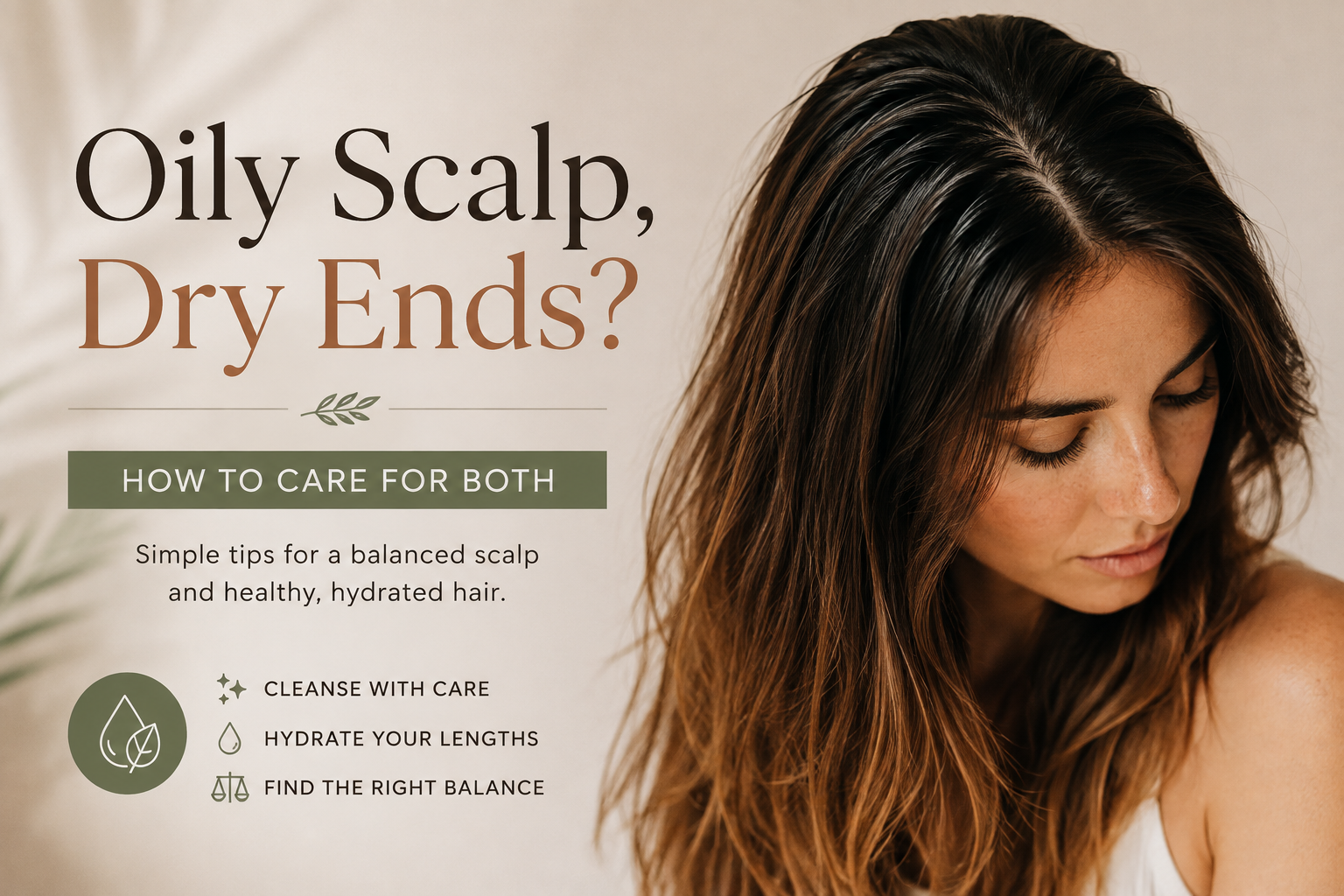
Oily Scalp, Dry Ends? How to Care for Both
Having an oily scalp and dry hair can feel like an impossible combination. You wash your hair to get rid of greasy roots, only to find that your lengths feel dry, rough or brittle afterwards. Then, a few hours or a day later, your scalp looks oily again.
The solution is not necessarily to wash your hair less or use stronger products. Instead, it is about understanding that your scalp and your hair lengths have different needs.
With the right routine, you can manage excess oil at the scalp while keeping your lengths hydrated, soft and healthy.
Why Do You Have an Oily Scalp and Dry Hair?
Your scalp naturally produces sebum, an oily substance that helps protect the skin and hair. Some people naturally produce more sebum than others, while factors such as hormones, genetics, stress, sweating and product buildup can also influence how oily your scalp becomes.
Your hair lengths, however, do not produce oil on their own. The further your hair grows from the scalp, the less easily natural oils can travel down the hair shaft. This can leave your roots oily while your mid-lengths and ends become increasingly dry.
Hair that has been coloured, heat-styled, chemically treated or exposed to environmental stress can be even more prone to dryness and breakage.
This is why oily roots do not necessarily mean your entire head of hair needs treatment for oiliness.
The Biggest Mistake: Stripping Your Entire Head of Hair
When your scalp feels greasy, it can be tempting to reach for a very strong shampoo or scrub your entire head thoroughly.
But repeatedly stripping away too much oil can leave your lengths feeling dry and your scalp uncomfortable. You may end up in a cycle of trying to remove oil while simultaneously trying to replace the moisture you’ve lost.
Instead, think of your hair in sections.
Your scalp needs thorough cleansing, while your mid-lengths and ends generally need more moisture and protection.
Focus Your Shampoo on Your Scalp
One of the simplest changes you can make is to focus your shampoo where you actually need it most.
When washing your hair, apply shampoo primarily to your scalp and roots. Gently massage the scalp with your fingertips to loosen oil, sweat and product buildup.
You do not need to aggressively scrub your lengths. As you rinse, the shampoo and water will naturally travel through the rest of your hair.
If your scalp is particularly oily or you have significant product buildup, a second gentle cleanse may be more effective than using an extremely harsh shampoo once.
The goal is to cleanse effectively without unnecessarily stripping your hair.
Don’t Skip Conditioner
If you have an oily scalp, you might be tempted to skip conditioner altogether. This can actually make your dry lengths more difficult to manage.
Instead, apply conditioner mainly to your mid-lengths and ends, keeping heavier products away from the scalp if they tend to make your roots greasy.
Conditioning helps improve softness, manageability and the feel of dry hair, making it easier to detangle and reducing unnecessary friction.
Your scalp can be oily while your ends still need plenty of moisture. Both things can be true at the same time.
How Often Should You Wash an Oily Scalp?
There is no single number of washes that works for everyone.
If your scalp becomes oily quickly, washing more frequently may simply be what your scalp needs. You do not have to force yourself to go several days without washing just because you have heard that washing your hair frequently is bad for it.
What matters is how you are washing.
A gentle shampoo, proper scalp cleansing and conditioner on the lengths can allow you to wash an oily scalp without constantly drying out the rest of your hair.
Pay attention to how your scalp feels. If it is greasy, uncomfortable or heavily coated with product, it may be time for a wash.
Avoid Very Hot Water
Hot showers can feel amazing, especially during colder weather, but very hot water can contribute to dryness and irritation.
Try washing your hair with comfortably warm or lukewarm water instead. This can help you cleanse your scalp without unnecessarily drying out your hair and skin.
You can also finish your routine with a cooler rinse if you enjoy the sensation, but there is no need for an ice-cold shower.
Be Careful With Dry Shampoo
Dry shampoo can be incredibly useful when you need to refresh oily roots between washes. However, it should not become a replacement for actually cleansing your scalp.
Applying large amounts repeatedly can contribute to product buildup and may leave your scalp feeling coated or uncomfortable.
Use dry shampoo strategically when needed, and make sure you properly cleanse your scalp afterwards.
If your scalp is consistently becoming oily very quickly, it may be more helpful to look at your overall hair care routine rather than continually adding more dry shampoo.
Watch What You Put on Your Scalp
Not every hair product needs to be applied directly to your scalp.
Heavy styling products, conditioners, masks and oils can make an already oily scalp feel even more weighed down. This does not mean you need to avoid nourishing ingredients altogether. It simply means that where you apply a product matters.
For example, a rich conditioner or hair mask may be perfect for your dry ends but unnecessary on your roots.
Similarly, scalp oils should not automatically be treated as the answer to every scalp concern. If your scalp is already producing plenty of oil, adding more oil may not be what it needs.
Choose products according to your individual scalp and hair needs rather than treating your entire head of hair the same way.
Don’t Forget About Buildup
Sometimes what looks like excessive oil is actually a combination of sebum and product buildup.
Styling products, dry shampoo, leave-in products and other formulas can accumulate on the scalp and hair over time. This can make your roots feel heavy, greasy or difficult to refresh.
Occasional deeper cleansing can help remove buildup, particularly if you use a lot of styling products.
However, clarifying your hair too frequently can leave dry lengths feeling stripped. As with everything else, balance is key.
Your Simple Routine for an Oily Scalp and Dry Hair
If you struggle with oily roots and dry ends, try keeping your routine simple:
Cleanse your scalp thoroughly. Focus your shampoo on the roots rather than aggressively scrubbing your lengths.
Double cleanse when necessary. If your scalp is particularly oily or has significant buildup, a second gentle wash may be more effective than using a harsh shampoo.
Condition your lengths. Apply conditioner primarily from the mid-lengths down to the ends.
Use a hair mask when needed. If your lengths are particularly dry or damaged, incorporate a nourishing treatment into your routine.
Protect your hair from heat. Use heat protection before blow-drying, straightening or curling.
Keep scalp products targeted. Choose scalp treatments based on your actual scalp needs rather than simply adding more products because your hair feels dry.
Cleanse away buildup regularly. Adjust your cleansing routine depending on how much product you use and how your scalp feels.
When Oily Scalp Could Indicate Another Scalp Concern
An oily scalp is not always simply a matter of having “too much oil”.
If you regularly experience persistent itching, redness, heavy flaking, irritation, unusual odour or significant changes in your scalp or hair, it may be worth speaking with a healthcare professional or dermatologist.
Scalp conditions can sometimes cause symptoms that look like ordinary oiliness, so it is important not to assume that stronger cleansing is always the answer.
The Bottom Line
Balancing an oily scalp does not mean stripping your hair until it feels squeaky clean.
The key is to treat your scalp and your hair lengths according to their individual needs. Cleanse the scalp effectively, keep conditioner and richer treatments focused on the lengths, manage buildup without overdoing it and avoid unnecessarily harsh products.
You can have an oily scalp and dry hair at the same time. Your routine simply needs to recognise that both concerns can exist together.
Healthy hair care is not about removing every trace of oil. It is about finding the right balance between cleanliness, moisture and protection.

R369.00
Estimated delivery dates: Sep 21, 2026 - Sep 24, 2026

R339.00
Estimated delivery dates: Sep 21, 2026 - Sep 24, 2026

R515.00
Estimated delivery dates: Sep 21, 2026 - Sep 24, 2026

R309.00
Estimated delivery dates: Sep 21, 2026 - Sep 24, 2026

R918.00 – R1,402.00Price range: R918.00 through R1,402.00
Estimated delivery dates: Sep 22, 2026 - Sep 25, 2026

R279.00
Estimated delivery dates: Sep 21, 2026 - Sep 24, 2026
R279.00
Estimated delivery dates: Sep 21, 2026 - Sep 24, 2026

R499.00
Estimated delivery dates: Sep 22, 2026 - Sep 25, 2026
R269.00
Estimated delivery dates: Sep 22, 2026 - Sep 25, 2026

R969.00
Estimated delivery dates: Sep 22, 2026 - Sep 25, 2026
R499.00
Estimated delivery dates: Sep 22, 2026 - Sep 25, 2026
R269.00
Estimated delivery dates: Sep 21, 2026 - Sep 24, 2026
R249.00
Estimated delivery dates: Sep 21, 2026 - Sep 24, 2026
Start your hair growth journey with us.
Take the Hair Assessment to get a your recommended products to support your hair growth journey
Final Thoughts
Balancing an oily scalp without drying out your hair comes down to understanding what your scalp and lengths actually need. You do not have to choose between greasy roots and dry, damaged ends.
Focus your cleansing on the scalp, keep conditioning treatments concentrated on the lengths, and avoid overusing harsh or heavy products. With a consistent routine tailored to your individual hair and scalp needs, you can keep your scalp feeling fresh while helping your lengths stay soft, hydrated and healthy.
The goal is not to eliminate oil, but to find a healthy balance that works for your hair.
Post Views: 72